BeOnd School logo

Course Catalog

Explore All Courses

Find the perfect online class for your child's age and interests.

Showing 1–12 of 64

3D Design: Bring Ideas, Robots to Life
Live Class Robotics Robotics

3D Design: Bring Ideas, Robots to Life

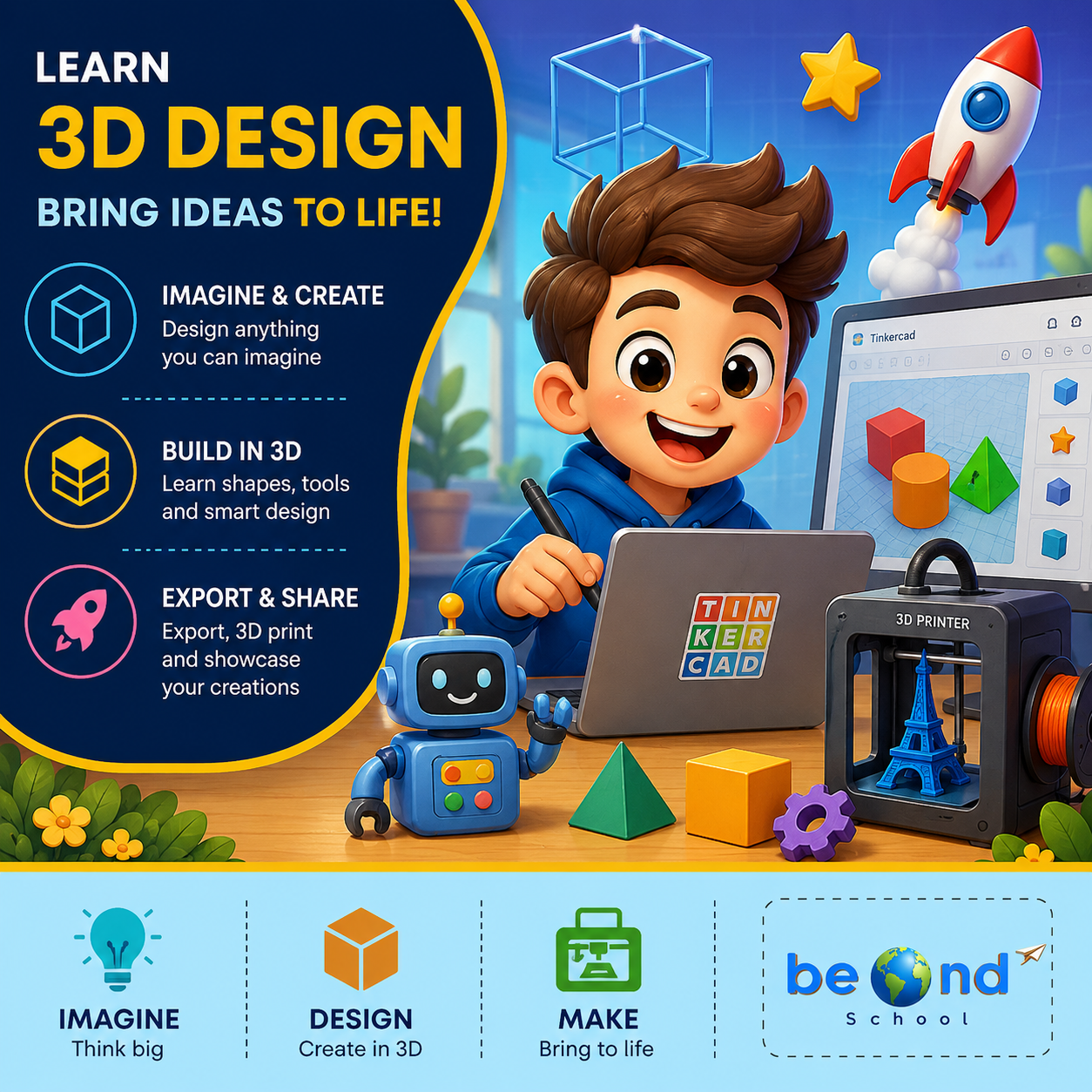
The 3D Designing course introduces students to the exciting world of 3D modelling, digital design, and creative problem-solving. Using Tinkercad's beginner-friendly design tools, students learn how simple shapes can be transformed into imaginative 3D creations. Throughout the course, they explore geometric shapes, resizing, grouping, alignment, holes, duplication, rotation, and advanced design techniques while building fun projects such as characters, objects, structures, and personalised models. By the end of the course, students will have the confidence to turn their imagination into digital 3D designs and understand the basics of preparing models for real-world applications such as 3D printing.Class 1: Welcome to the World of 3D DesignStudents explore the Tinkercad workspace and create their first model using basic 3D shapes.Class 2: Shape Builders: Move, Resize & RotateStudents learn to transform basic shapes by moving, resizing, and rotating them in 3D space.Class 3: Shape Fusion: Grouping & Combining ObjectsStudents combine simple shapes to construct more detailed and creative 3D objects.Class 4: Design with Precision: Align & DuplicateStudents use precision tools to create balanced designs with repeated and symmetrical elements.Class 5: The Power of Holes: Cut & CarveStudents discover how hole shapes can be used to carve, cut, and transform 3D objects.Class 6: Character Creator: Build a 3D CharacterStudents bring imagination to life by designing their own unique 3D character.Class 7: Cool Creations: Designing Everyday ObjectsStudents apply their design skills to create functional objects inspired by everyday life.Class 8: Architects in 3D: Build a Mini StructureStudents become young architects by designing a creative structure in a 3D environment.Class 9: Minecraft-Inspired 3D Design ChallengeStudents create a fun game-inspired 3D model by transforming basic shapes into a detailed character or object.Class 10: Duplicate Like a Designer: Patterns & RepetitionStudents use duplication and repetition to create complex patterns quickly and efficiently.Class 11: From Digital Model to Real World: Introduction to 3D PrintingStudents discover how digital 3D models can be transformed into real physical creations through 3D printing.Class 12: Ultimate 3D Design Challenge: Imagine, Design & ShowcaseStudents design and showcase an original 3D creation that brings together everything learned throughout the course.

Computational Thinking Explorers | Grade 3
Live Class AI & Robotics

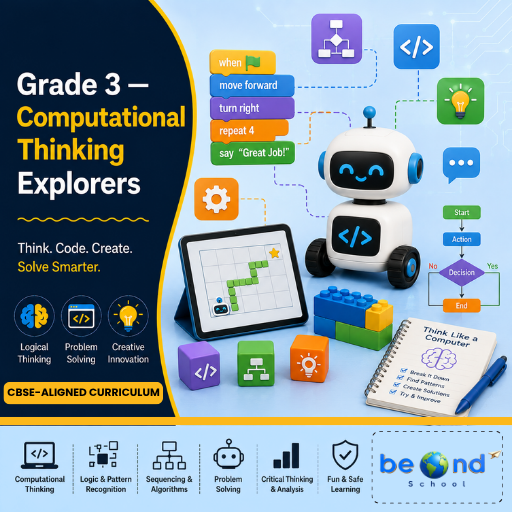
Computational Thinking Explorers | Grade 3

AI & Robotics course helps learners develop computational thinking and problem-solving skills through engaging puzzles, patterns, logic challenges, digital activities, coding, and robotics. Students learn to recognize patterns, understand transformations and 3-D views, break complex problems into smaller clues, read and create simple charts, and develop step-by-step algorithms. They also build essential digital literacy skills by exploring computer components and online safety, before applying their learning through introductory block coding and robotics activities. Throughout the course, students practice reasoning, creativity, independent thinking, collaboration, and communication, culminating in a Puzzle Trail Capstone Project where they combine multiple computational thinking skills into a project they design, test, improve, and showcase.Module 1 |Class 1 - 8| — See Patterns & Think CreativelyTransformations → 3-D Views → Missing Pieces → Number & Shape Patterns → Mixed PatternsStudents build strong foundations in visual reasoning and pattern recognition by exploring transformations, 3-D views, missing pieces, number patterns, shape patterns, letter patterns, and mixed-format combinations.Module 2 |Class 9 - 16| — Break Problems Down & Build SolutionsClues → Charts → Algorithms → Directions → Grid PuzzlesStudents learn to break problems into manageable parts, interpret information from charts, create step-by-step algorithms, and solve grid and direction challenges while strengthening their computational reasoning.Module 3 |Class 17 - 24| — Explore Technology & BuildComputer Skills → Online Safety → Block Coding → Robotics → Puzzle Trail CapstoneStudents develop practical digital skills, learn foundational online safety, take their first steps into block coding and robotics, and bring everything together through a creative computational-thinking capstone project.

Think Like a Computer: Play-Based Logic & Robot Readiness | Grade 2
Live Class AI & Robotics

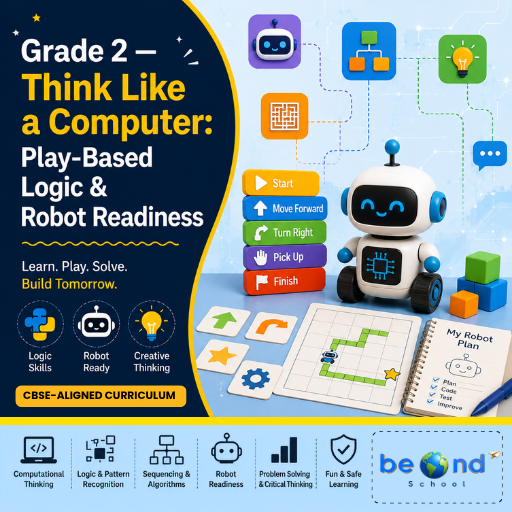
Think Like a Computer: Play-Based Logic & Robot Readiness | Grade 2

AI & Robotics course introduces learners to the core thinking skills behind computers, robots, and artificial intelligence through engaging, play-based, and hands-on activities. Students discover how computers and robots follow instructions, identify patterns, organize information, navigate paths, make decisions using if-then logic, sequence events, and solve problems using clues and rules. As they build their skills, students take on creative robot-design challenges that encourage problem-solving, collaboration, testing, and clear communication of their ideas. The course culminates in a Robot Village Capstone Project, where students work together to plan, build, test, improve, and showcase a village featuring three robot helpers.Module 1 |Class1-8| — Robot Thinking FoundationsInstructions → Patterns → Sorting → NavigationStudents develop foundational computational thinking through instructions, patterns, sorting, and navigation activities.Module 2 |Class9-16| — Logic, Decisions & SequencingIf-Then Logic → Sequencing → Symmetry → Number PatternsStudents learn to recognize rules, make logical decisions, organize information, and identify patterns through if-then games, story sequencing, symmetry, and number challenges.Module 3 |Class17-24| — Problem-Solving & Robot DesignClues → Problem Solving → Robot Design → TestingStudents learn to break problems into smaller clues and apply their problem-solving skills to designing, building, testing, and presenting their own robot helpers.Module 4 |Class25-32| — Team Logic & CollaborationRules → Teamwork → Strategy → ReflectionStudents transition from individual challenges to collaborative problem-solving, learning how to apply multiple rules, share ideas, resolve disagreements, explain strategies, and improve team solutions.Module 5 |Class33-40 |— Robot Village Planning & BuildingPlanning → Robot Jobs → Design → Building → TestingStudents begin their major capstone by planning a Robot Village, defining robot jobs, sketching designs, building prototypes, testing their creations, and improving them through teamwork.Module 6 |Class41-48| — Robot Village Logic & ShowcaseSequencing → Sorting Logic → Debugging → Presentation → CapstoneStudents bring together everything they have learned by adding logic to their robots, debugging and improving their designs, preparing their presentations, and showcasing their completed Robot Village.

CHESS ADVENTURES: Learn Chess Through Stories!
Live Class Chess

CHESS ADVENTURES: Learn Chess Through Stories!

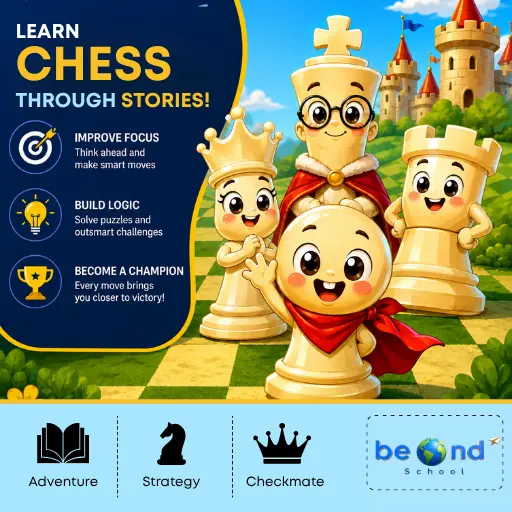
Enter the Kingdom of 64 Squares, where the White and Black Courts face off in a battle of strategy and skill. At the Royal Chess Academy, young cadets learn to think ahead, plan their moves, and protect their kingdom.Across 12 exciting classes, students discover each chess piece, master special moves, learn powerful tactics, and take on new challenges. Their journey builds toward the Grand Tournament, where they put their skills to the test and become true Knights of the 64 Squares. CLASS 1: Welcome to the Kingdom of Sixty-Four SquaresSet up the chessboard, identify the pieces, and learn ranks, files, and board orientation. CLASS 2: Sir Pawn and the March of the Brave Foot SoldiersLearn pawn movement, diagonal captures, and promotion. CLASS 3: The Rook Twins and the Towers of the RealmMaster rook movement, captures, and the power of open files. CLASS 4: The Bishop Mystics of the Diagonal RealmExplore diagonal movement, square colors, and the bishop pair. CLASS 5: Sir Knight's Legendary LeapMaster the knight’s L-shaped moves, jumps, and basic forks. CLASS 6: Queen Seraphina, Ruler of All DirectionsLearn queen movement, value, protection, and safe development. CLASS 7: King Aldric and the Secret of CastlingLearn safe king movement and the rules for kingside and queenside castling. CLASS 8: The Council of Secret MovesPractice en passant, pawn promotion, and special chess moves. CLASS 9: Check! The Shadow Legion AttacksRecognize check and learn three ways to escape it: move, block, or capture. CLASS 10: Checkmate! The Final StandUnderstand checkmate and stalemate and practice basic checkmate patterns. CLASS 11: The Knights' Code: Tactics & Battle StrategiesDiscover forks, pins, skewers, and discovered attacks to win material. CLASS 12: The Grand Tournament & CoronationApply opening principles, play a complete game, explain strategies, and demonstrate good sportsmanship.

Grade 9 Math — Algebra I — Full-Year Common Core Course
Live Class Math

Grade 9 Math — Algebra I — Full-Year Common Core Course

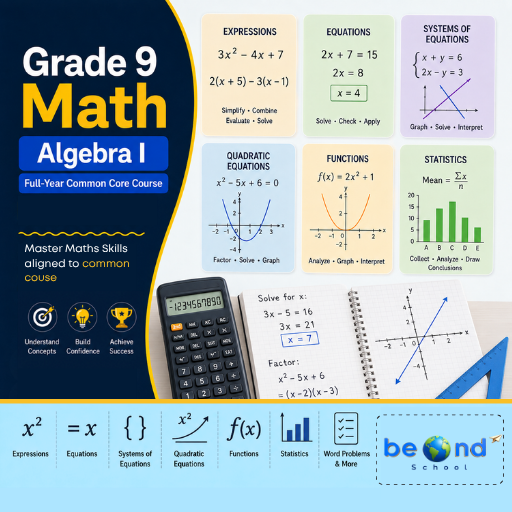
This course delivers a full year of Algebra I, covering six core strands: expressions, equations, systems of equations, quadratics, functions, and statistics. Sessions build from foundational algebraic manipulation through linear, quadratic, and exponential reasoning, formalizing function notation and modeling along the way — establishing the algebraic fluency required for Geometry and Algebra II.Course Strands & Progression1. Expressions & StructureInterpret expressions that represent a quantity in terms of its contextUse the structure of an expression to identify ways to rewrite it (factoring, recognizing patterns)Perform arithmetic operations on polynomials, and factor polynomials using common structuresRewrite rational expressions and simplify using properties of exponents2. Equations & InequalitiesCreate equations and inequalities in one variable to represent real-world relationshipsSolve linear equations and inequalities, including those with variables on both sidesRearrange formulas to solve for a quantity of interest (literal equations)Solve quadratic equations by inspection, factoring, completing the square, and the quadratic formulaUnderstand solving equations as a process of reasoning, and justify each step3. Systems of EquationsCreate systems of linear equations and inequalities to represent real-world relationshipsSolve systems of linear equations algebraically (substitution, elimination) and graphicallySolve a simple system of a linear and a quadratic equationInterpret solutions to systems in context, including no-solution and infinite-solution cases4. FunctionsUnderstand function notation, and interpret statements using function notation in contextCompare properties of two functions represented in different ways (algebraically, graphically, numerically, verbally)Interpret key features of graphs (intercepts, intervals of increase/decrease, extrema, symmetry) in contextWrite functions that describe a relationship between two quantities, including arithmetic and geometric sequencesDistinguish between linear and exponential models, and recognize situations modeled by each5. Quadratic & Exponential RelationshipsAnalyze quadratic functions using graphs, tables, and equations (vertex form, standard form)Interpret the effects of transformations on quadratic and exponential graphsCompare linear, quadratic, and exponential models to determine which best fits a given data setSolve real-world problems modeled by quadratic and exponential functions6. Statistics & Data InterpretationRepresent data with plots on the real number line (dot plots, histograms, box plots)Use statistics appropriate to the shape of a data distribution to compare center and spread of two or more data setsSummarize, represent, and interpret data on two categorical and quantitative variables, including two-way tablesFit a linear function to data and use it to solve problems, distinguishing correlation from causation

Grade 8 Math — Full-Year Common Core Course
Live Class

Grade 8 Math — Full-Year Common Core Course

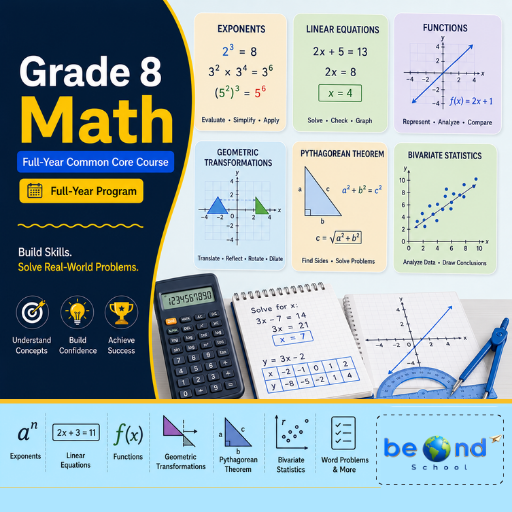
This course completes middle school mathematics and builds the direct foundation for high school algebra, covering six core strands: exponents and scientific notation, linear equations, functions, geometric transformations, the Pythagorean theorem, and bivariate statistics. Sessions move students from numerical reasoning into formal algebraic and functional thinking, and introduce transformational geometry and informal proof — the capstone of the K–8 progression.Course Strands & Progression1. Exponents, Radicals & the Number SystemKnow and apply the properties of integer exponentsUse square roots and cube roots to represent solutions to equationsExpress very large and very small numbers using scientific notation, and perform operations with numbers in scientific notationUnderstand that not all numbers are rational, and approximate irrational numbers using rational approximations2. Linear Equations & SystemsSolve linear equations in one variable, including equations with variables on both sidesUnderstand solutions to linear equations as points on a line, and analyze slope and interceptsSolve systems of two linear equations by graphing, substitution, and eliminationSolve real-world and mathematical problems leading to systems of linear equations3. FunctionsUnderstand that a function assigns exactly one output to each inputCompare properties of two functions represented in different ways (tables, graphs, equations, verbal descriptions)Interpret the equation y = mx + b as defining a linear function, and construct functions to model linear relationshipsDescribe qualitatively the functional relationship between two quantities from a graph4. Geometric Transformations & Congruence/SimilarityVerify experimentally the properties of rotations, reflections, and translationsUnderstand congruence and similarity using physical models, transparencies, or geometry softwareDescribe the effect of dilations, translations, rotations, and reflections on two-dimensional figures using coordinatesUnderstand and apply facts about angles formed by parallel lines cut by a transversal, and angle sums of triangles5. The Pythagorean TheoremExplain a proof of the Pythagorean theorem and its converseApply the Pythagorean theorem to determine unknown side lengths in right triangles, in real-world and mathematical problemsApply the Pythagorean theorem to find the distance between two points in a coordinate systemSolve real-world problems involving volume of cylinders, cones, and spheres6. Bivariate StatisticsConstruct and interpret scatter plots for bivariate measurement dataDescribe patterns of association (clustering, outliers, positive/negative association, linear/nonlinear)Fit a straight line to data that suggests a linear association, and informally assess model fitUse the equation of a linear model to solve problems in contextConstruct and interpret two-way tables for categorical data

Grade 7 Math — Full-Year Common Core Course
Live Class Math

Grade 7 Math — Full-Year Common Core Course

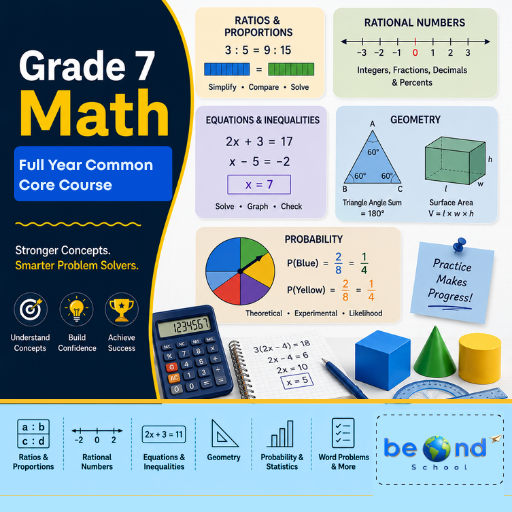
This course deepens seventh-grade mathematical fluency and reasoning across five core strands: ratios and proportional relationships, the rational number system, expressions and equations, geometry, and statistics and probability. Sessions extend proportional reasoning to real-world and multi-step contexts, formalize computation with all rational numbers, and introduce probability as a new lens for analyzing uncertainty — building the foundation for algebra.Course Strands & Progression1. Ratios & Proportional RelationshipsCompute unit rates involving ratios of fractionsRecognize and represent proportional relationships between quantities (tables, graphs, equations)Identify the constant of proportionality and interpret it in contextSolve multi-step ratio and percent problems (simple interest, tax, tips, markups, markdowns, percent increase/decrease)2. The Number SystemApply and extend understanding of addition and subtraction to all rational numbers, including negativesApply and extend understanding of multiplication and division to all rational numbersConvert rational numbers to decimals using long divisionSolve real-world problems involving the four operations with rational numbers3. Expressions & EquationsApply properties of operations to add, subtract, factor, and expand linear expressionsRewrite expressions in different but equivalent forms to reveal how quantities relateSolve multi-step real-world and mathematical problems using positive and negative rational numbersSolve word problems leading to equations of the form px + q = r and p(x + q) = rSolve word problems leading to inequalities, and graph the solution set4. GeometrySolve problems involving scale drawings and reproduce a figure at a different scaleDraw geometric shapes with given conditions, including from three-dimensional figuresSolve problems involving angle relationships (supplementary, complementary, vertical, adjacent)Solve problems involving area, circumference, and other properties of circlesSolve problems involving surface area and volume of three-dimensional objects (prisms, pyramids)5. Statistics & ProbabilityUnderstand and use random sampling to draw inferences about a populationDraw informal comparative inferences about two populations using measures of center and variabilityUnderstand probability as a number between 0 and 1, and approximate probability through observed frequencyDevelop, use, and evaluate probability models, including for compound events

Grade 6 Math — Full-Year Common Core Course
Live Class Math

Grade 6 Math — Full-Year Common Core Course

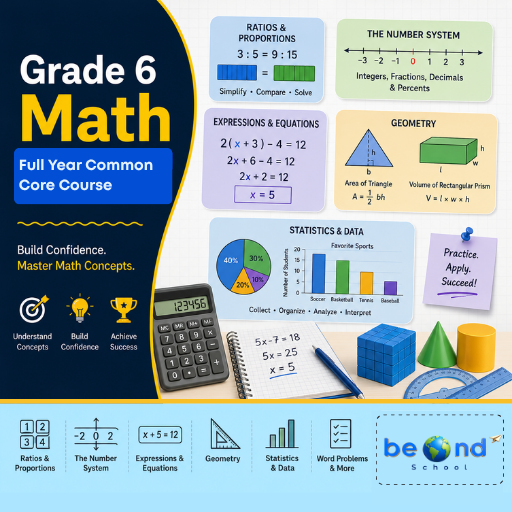
This course establishes sixth-grade mathematical fluency and reasoning across five core strands: ratios and proportional relationships, the number system, expressions and equations, geometry, and statistics. Sessions mark students' transition from arithmetic to early algebraic thinking, introducing negative numbers, variables, and data analysis as formal tools for reasoning about real-world situations.Course Strands & Progression1. Ratios & Proportional RelationshipsUnderstand the concept of a ratio and use ratio language to describe relationshipsUse ratio and rate reasoning to solve real-world problems (tables, tape diagrams, double number lines)Find a percent of a quantity, and solve problems involving finding the whole given a part and percentConvert measurement units using ratio reasoning2. The Number SystemDivide fractions by fractions and solve related word problemsFluently divide multi-digit numbers and compute with multi-digit decimalsUnderstand positive and negative numbers, including their use to represent real-world quantitiesUnderstand and use absolute valuePlot and interpret points in all four quadrants of the coordinate plane3. Expressions & EquationsWrite, read, and evaluate expressions with variablesApply properties of operations to generate equivalent expressionsSolve one-variable equations and inequalitiesUnderstand and analyze the relationship between two variables using tables, graphs, and equations4. GeometryFind the area of triangles, quadrilaterals, and other polygons by composing and decomposing shapesFind the volume of right rectangular prisms with fractional edge lengthsDraw polygons in the coordinate plane using given coordinatesRepresent three-dimensional figures using nets, and find surface area5. Statistics & ProbabilityRecognize and formulate statistical questionsDescribe a data set's center, spread, and overall shapeDisplay numerical data using dot plots, histograms, and box plotsSummarize data sets using measures of center (mean, median) and variability (range, interquartile range)

Grade 5 Math: Full-Year Common Core Course
Live Class Math

Grade 5 Math: Full-Year Common Core Course

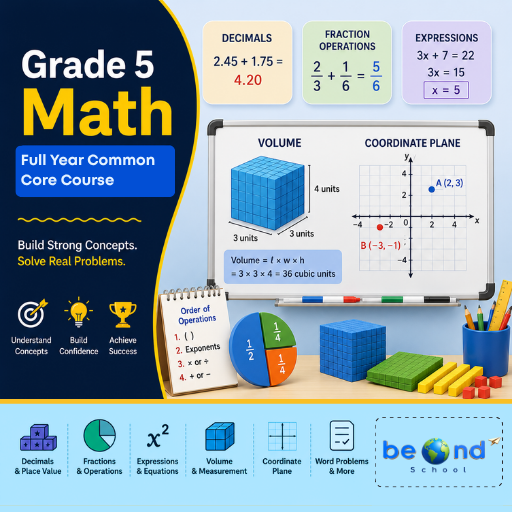
This course develops fifth-grade mathematical fluency and reasoning across five core strands: decimals, fraction operations, expressions, volume, and the coordinate plane. Sessions build from place value and decimal reasoning through increasingly complex fraction computation and algebraic thinking, culminating in geometric measurement and graphing — preparing students for the transition to middle school math.Course Strands & Progression1. Place Value & DecimalsUnderstand place value relationships to the thousandths, including powers of 10Read, write, and compare decimals to the thousandthsRound decimals to any placeAdd, subtract, multiply, and divide decimals to hundredths using place value strategies2. Fraction OperationsAdd and subtract fractions with unlike denominators, including mixed numbersMultiply fractions and mixed numbers, and interpret multiplication as scalingDivide unit fractions by whole numbers and whole numbers by unit fractionsSolve real-world problems involving fraction operations3. Multi-Digit Arithmetic & ExpressionsFluently multiply multi-digit whole numbersDivide up to 4-digit dividends by 2-digit divisorsWrite and interpret numerical expressions using grouping symbols (parentheses, brackets, braces)Generate and analyze numerical patterns and relationships between two patterns4. Measurement & VolumeConvert measurements within a system (e.g., cm to m, grams to kilograms)Understand volume as an attribute of solid figuresMeasure volume using unit cubes and apply volume formulas (V = l × w × h) to rectangular prismsSolve real-world problems involving volume, including composite figures5. Geometry & the Coordinate PlaneUnderstand the coordinate plane: plot and interpret ordered pairs in the first quadrantRepresent real-world and mathematical problems using graphingClassify two-dimensional figures based on properties of their categoriesUnderstand the hierarchy of quadrilaterals and other polygons

Grade 4 Math — Full-Year Common Core Course
Live Class Math

Grade 4 Math — Full-Year Common Core Course

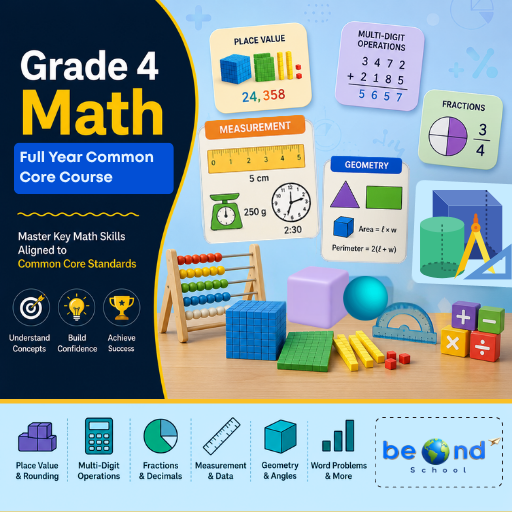
This course builds fourth-grade mathematical fluency and reasoning across five core strands: place value, multi-digit arithmetic, fractions, measurement, and geometry. Sessions progress from concrete, visual models toward abstract computation and problem-solving, with consistent review woven in so earlier skills stay sharp as new ones are introduced.Course Strands & Progression1. Place Value & Number SenseRead, write, and compare multi-digit whole numbers (up to 1,000,000)Understand place value relationships (a digit in one place represents 10 times what it represents in the place to its right)Round multi-digit numbers to any place2. Multi-Digit OperationsFluently add and subtract multi-digit whole numbers using the standard algorithmMultiply a number by up to a 4-digit number by a 1-digit number, and two 2-digit numbersDivide up to 4-digit dividends by 1-digit divisors, including interpreting remaindersSolve multi-step word problems using the four operations3. FractionsExtend understanding of fraction equivalence and orderingAdd and subtract fractions with like denominators, including mixed numbersMultiply a fraction by a whole numberUnderstand decimal notation for fractions and compare decimals to hundredths4. Measurement & DataConvert measurements within a single system (e.g., km to m, hours to minutes)Solve problems involving distance, time, liquid volume, mass, and moneyApply area and perimeter formulas to solve real-world problemsRepresent and interpret data, including line plots with fractional unitsUnderstand and measure angles in degrees5. GeometryIdentify and classify lines, angles, and shapes based on propertiesRecognize lines of symmetryClassify two-dimensional figures based on angle and side properties

Book a Free Class

Tell us a bit about your child to book a free demo class for the selected course.