
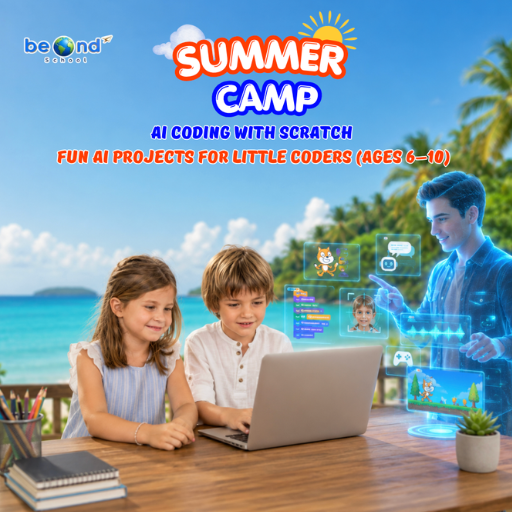
1.Build AI-Powered Apps & Games 2.Understand How AI Sees the World 3.Develop Problem-Solving Through AI 4.Gain Confidence as Creators

BeOnd School
Booking Overview
- Age 6 – 10
- Duration 2 Weeks
- 8 Classes
- Understand What AI Is (and Isn’t
- Learn How AI Learns from Examples
- See How AI Decides — and Why It Fails
- Build Confidence to Keep Exploring
AI Coding with Scratch is the perfect first step into artificial intelligence for young children. Designed specifically for ages 6–10, this course uses Scratch — the world’s most popular beginner coding platform — alongside friendly AI tools like Machine Learning for Kids and Google’s Teachable Machine to make AI feel accessible, exciting, and genuinely fun. Across 8 live sessions, children explore what AI really is, train their own image and pose recognition models, build a clap-controlled game, create a friendly chatbot, and finish by designing a Smart Traffic Light that makes decisions just like a real AI system. Every lesson is hands-on, every concept is shown through play, and every child leaves with projects they’re proud to show off. No coding experience needed — just curiosity.
Class 1: What Is AI? Humans vs Computers
The adventure begins with the biggest question of all — what actually is AI? Through playful comparisons between how humans think and how computers follow rules, young learners build their very first Scratch project: a character that reacts to different situations using coded rules. Simple, surprising, and the perfect spark to ignite curiosity.
Class 2: Rules vs Smart Behaviour
What makes something seem ‘smart’? This lesson helps children discover the difference between a computer that just follows rules and one that appears to think. They build a Smart Pet in Scratch — a character that reacts differently depending on whether they feed it, clap, or ignore it — making the concept of responsive, rule-based behaviour genuinely tangible.
Class 3: Can Computers Listen?
Can a computer actually hear you? Students explore the idea that sound is a form of data, then put it to the test using Scratch’s microphone extension. They build a clap-controlled or voice-reactive game where their real-world sounds directly control what happens on screen — a delightful ‘aha’ moment for every young learner.
Class 4: Teaching a Computer with Pictures
This is the lesson that truly blows young minds — students don’t just use AI, they teach it! Using the beginner-friendly Machine Learning for Kids platform, they train an image classifier to recognise animals or objects by showing it examples. It’s a hands-on introduction to machine learning that makes the concept click in minutes.
Class 5: When AI Makes Mistakes
Great AI comes from understanding where it goes wrong. Students test the models they trained, deliberately try to trick them, and observe what happens when predictions fail. Through fun, concrete examples they learn about training data and bias — building the kind of critical AI literacy that will serve them for life.
Class 6: Body as an Input: Pose AI
Their whole body becomes the controller! Students use Google’s Teachable Machine to train an AI that recognises different body poses — arms up, crouching, jumping — and then connect it to a Scratch game where those poses trigger on-screen actions. It’s active, physical, and one of the most memorable lessons in the course.
Class 7: Talking with a Computer
Ever wonder how Siri or Alexa seems to understand you? This lesson pulls back the curtain on chatbots, showing children how they work through rules and pattern matching. Students build their own simple, friendly chatbot using Scratch text blocks — one that can greet visitors, answer questions, and respond to specific phrases.
Class 8: How AI Makes Decisions
The final lesson ties everything together with a look at how AI uses inputs to make decisions — just like a traffic light that reads the road before it changes colour. Students build a Smart Traffic Light or decision-based game in Scratch, applying everything they’ve learned into one satisfying, complete project that celebrates how far they’ve come.